

Source inclusion
Which records may be retrieved at all, by rule.
Knowledge Mesh
It reads your sources in place, applies the caller’s permissions, decides which passage governs, and answers with the citation.
Grounding
Quoted
Sources
Read in place
Precedence
One passage
Freshness
On change
Audit
Every lookup
The layer itself, then the business case in three scenes: the estate as it stands, the layer that decides what governs, and the applications that share it.
Reads, filters, decides, then cites.
Similar articles, different ages.
Filtered, scoped, ranked, then cited.
Search, service and agents ask it.

Ask us for a retrieval trace
Illustrative scene, not a product capture
Capability 1 of 4: What the layer does
Every source is connected on the terms its own system uses.
Only named objects.Your conditions select them.

Choose sites and libraries.Metadata filters them again.

Your team writes conditions.That encoded query runs.

Your database team’s views.Read-only, nothing beyond.
Parsed and scanned pages.Sections, tables kept apart.
Its own owner and inclusion.Its own access and refresh.
Each source keeps its identity, version, address and watermark
Comprehensive in, salient out: a request is filtered by rights, narrowed, ranked, and settled by the rule that governs when sources disagree; the answer is cited.
Five decisions stay separate, so each one stays reviewable.
Which records may be retrieved at all, by rule.
Who may see a record, filtered at retrieval.
The part of the business this assistant serves.
Which eligible record answers the question.
Conditions, timing and precedence, declared.
Cited to source and version, or an honest no.
A cited answer or an honest no
Eight product captures, one per capability, each a demonstration with sample data and labelled as such, so an evaluator sees the screen and not a diagram of it.
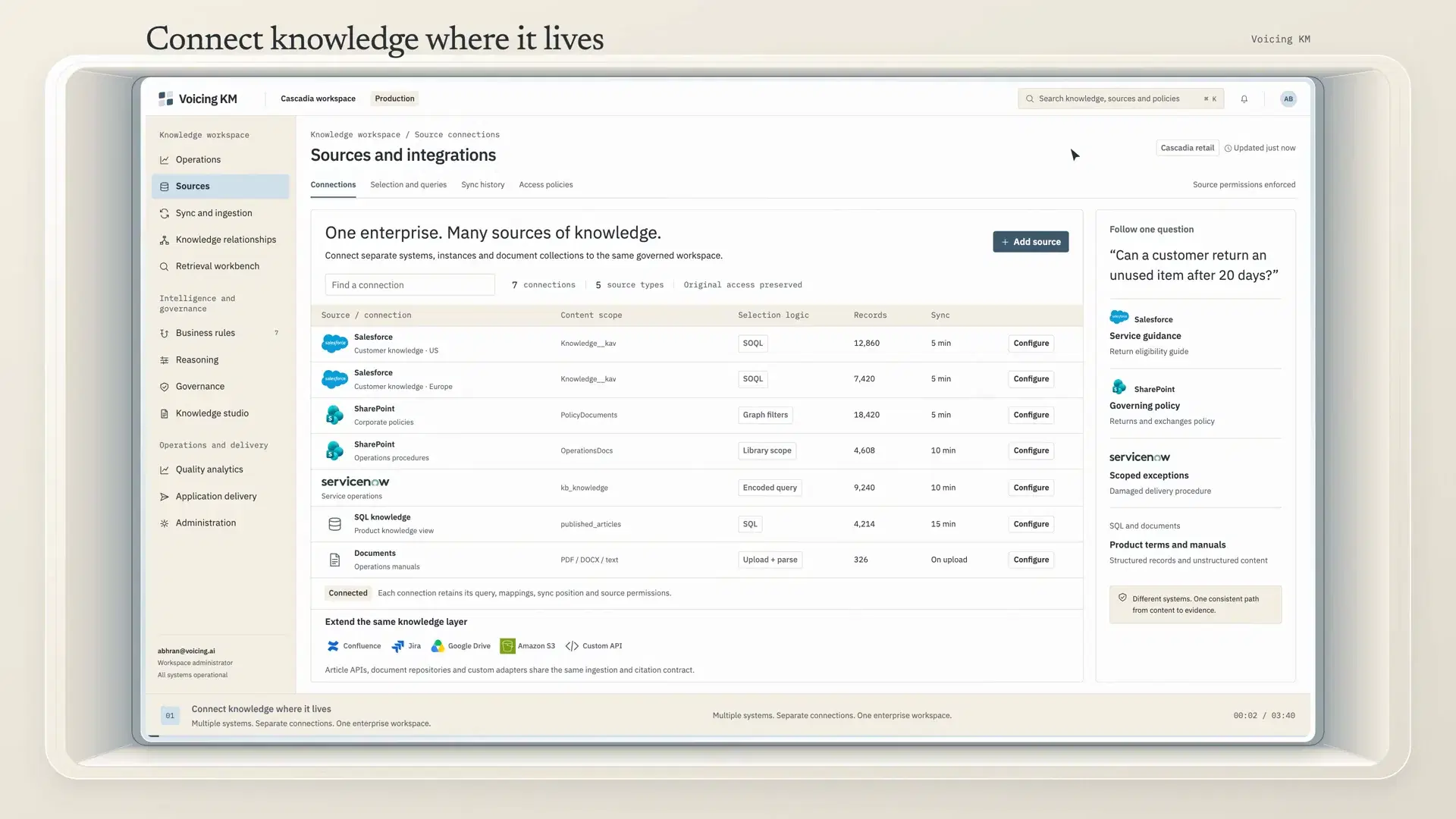
Each system keeps its own rules.
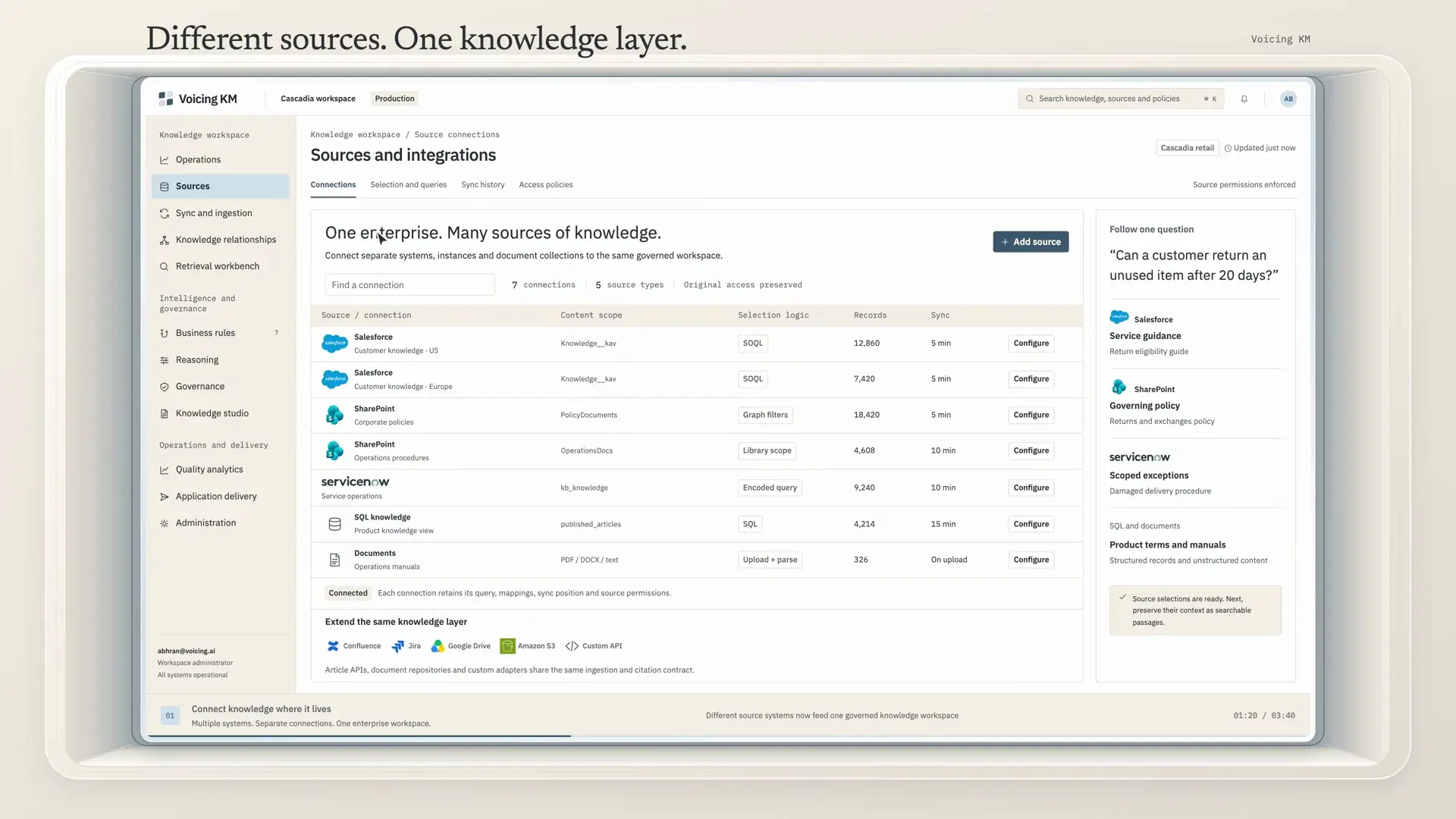
Separate systems, one place to ask.
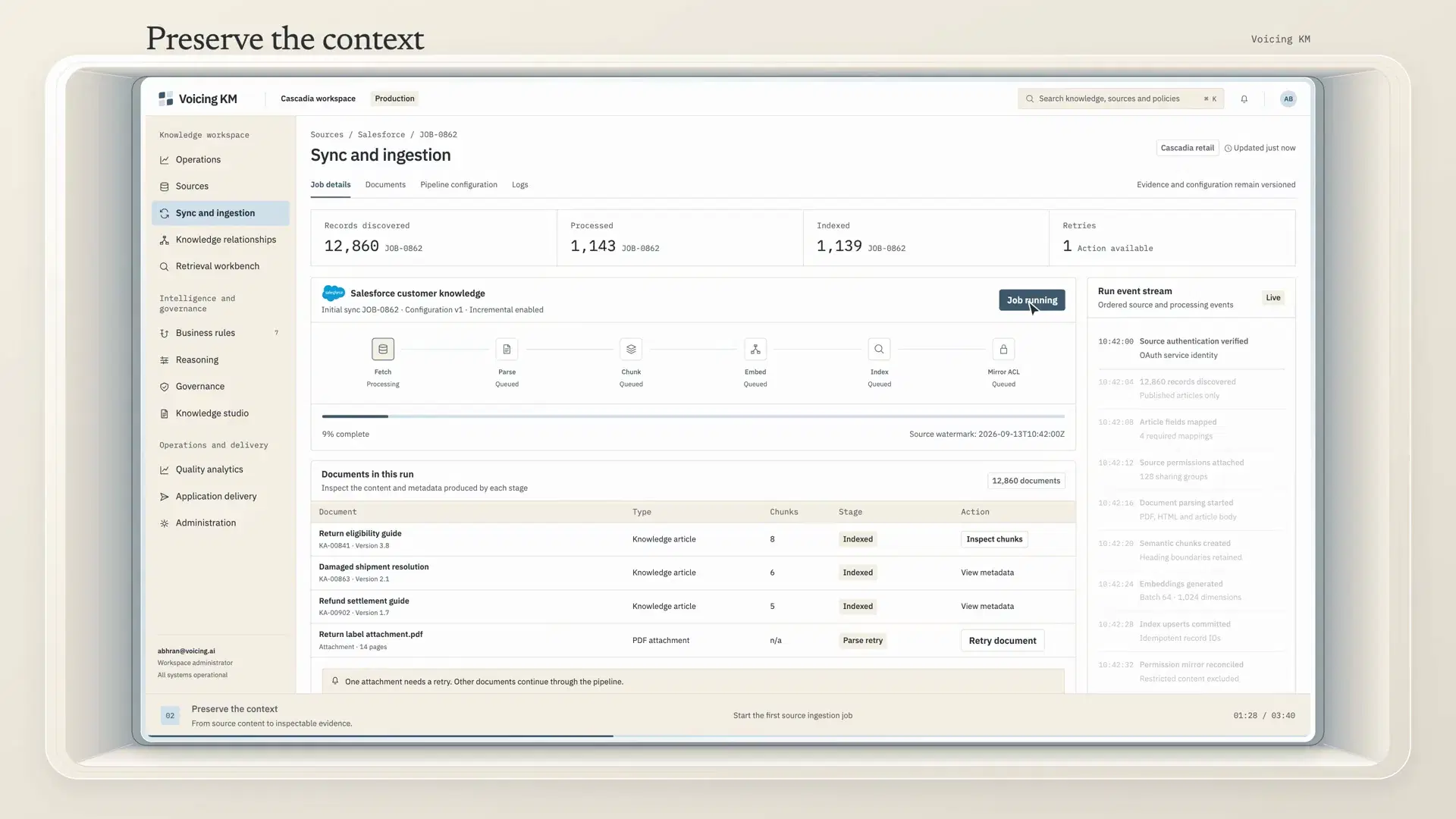
Source and version ride with it.
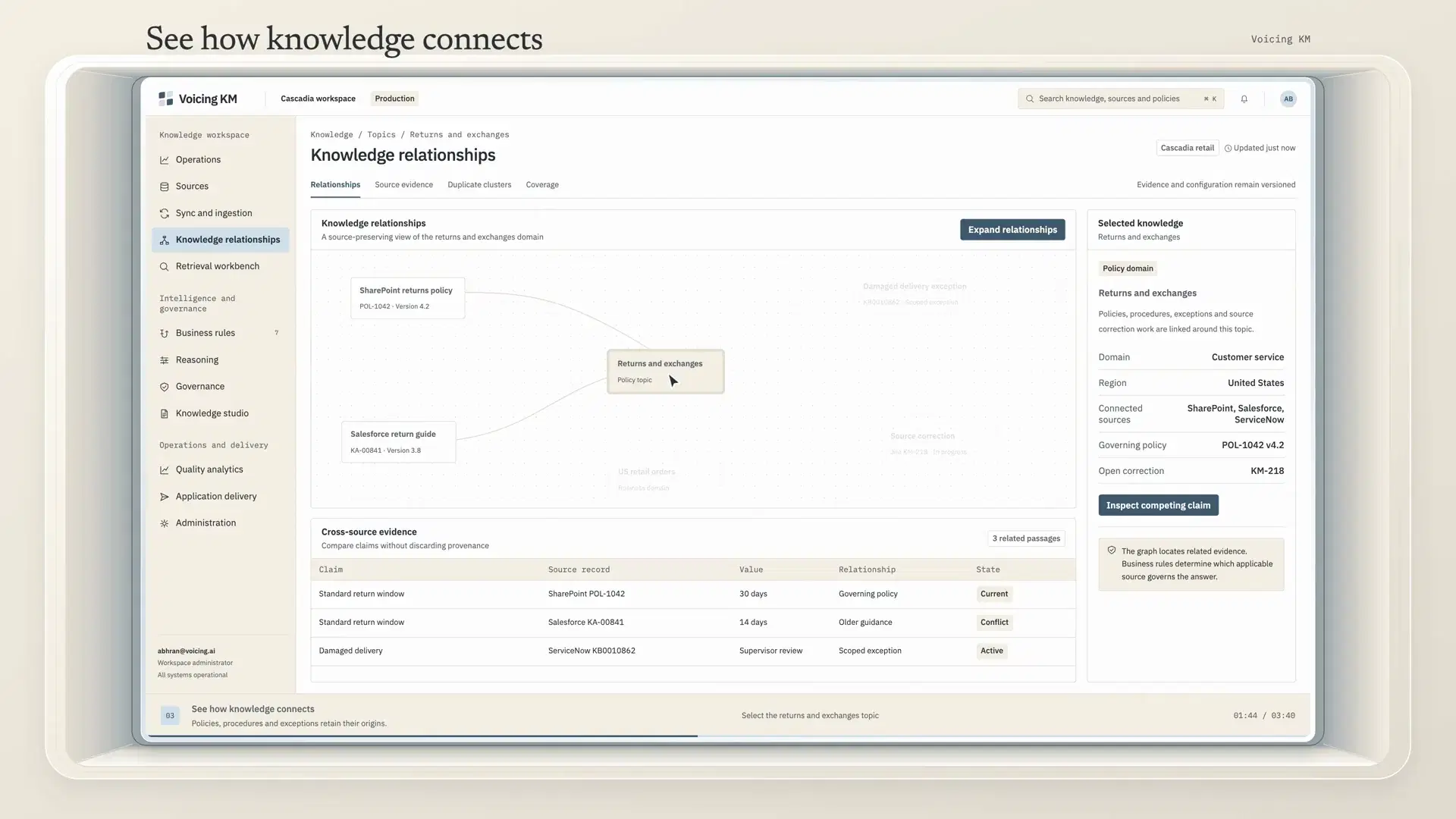
Related policies, shown together.
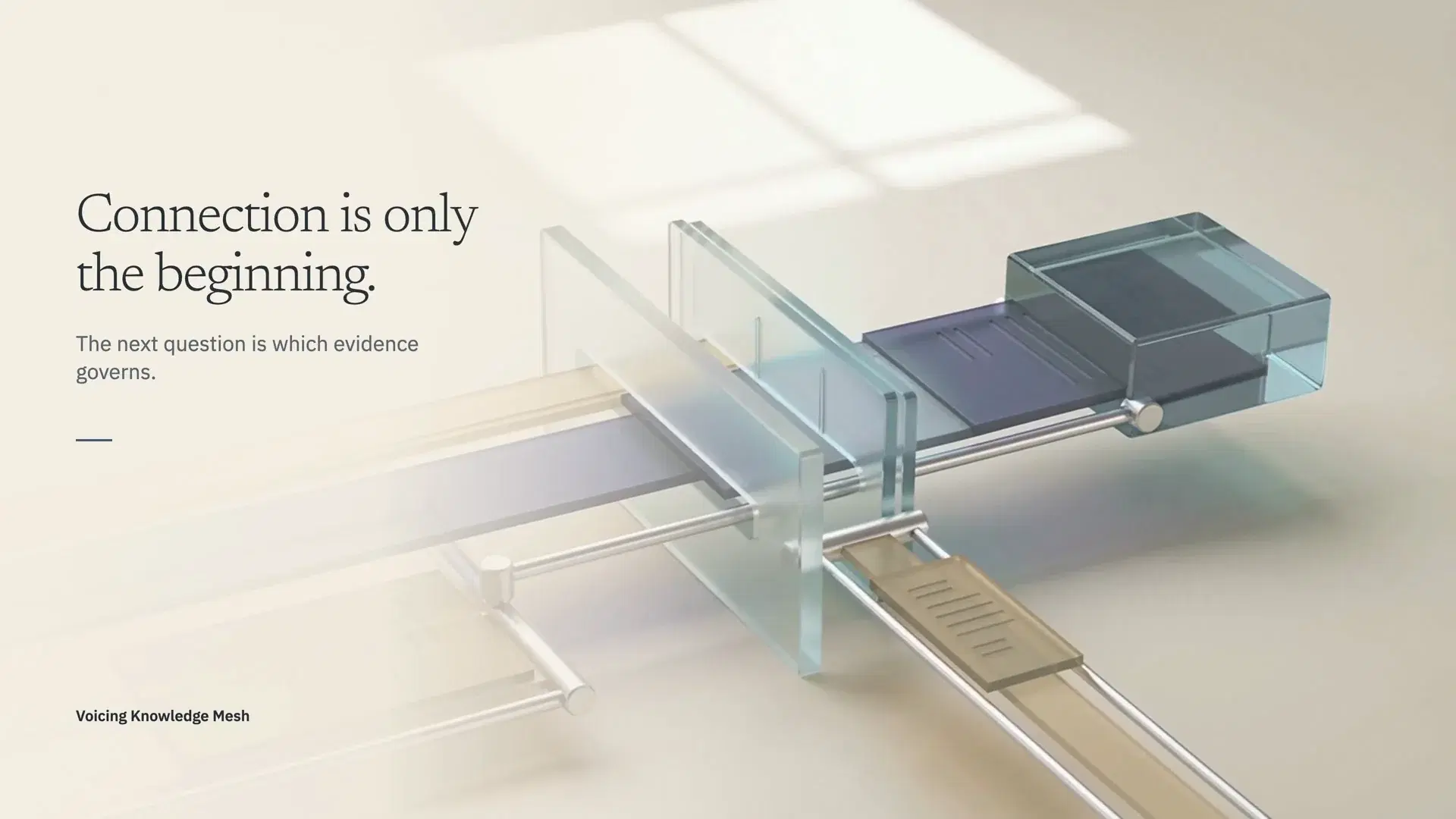
Scope and precedence decide it.
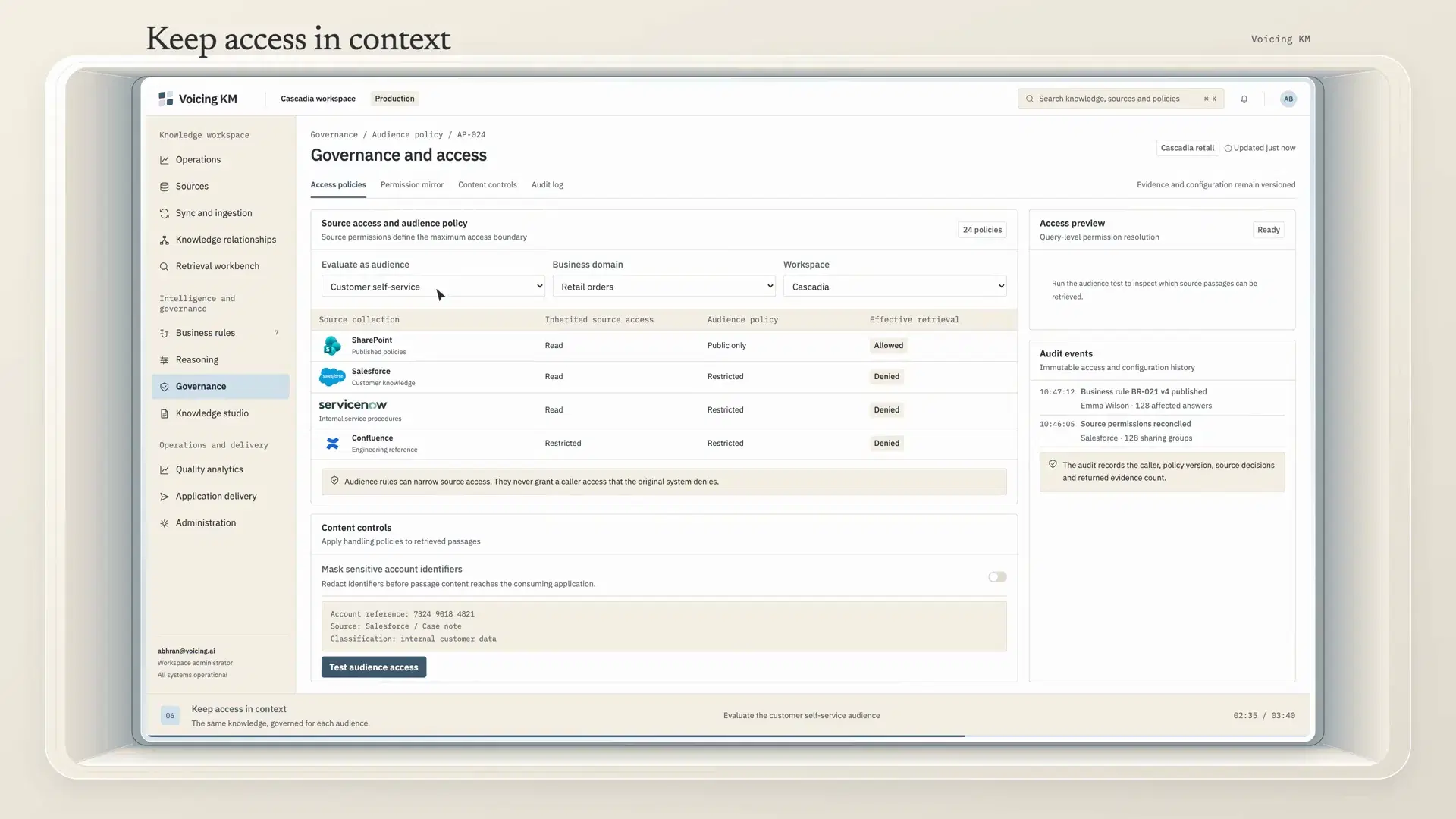
The caller’s rights decide first.
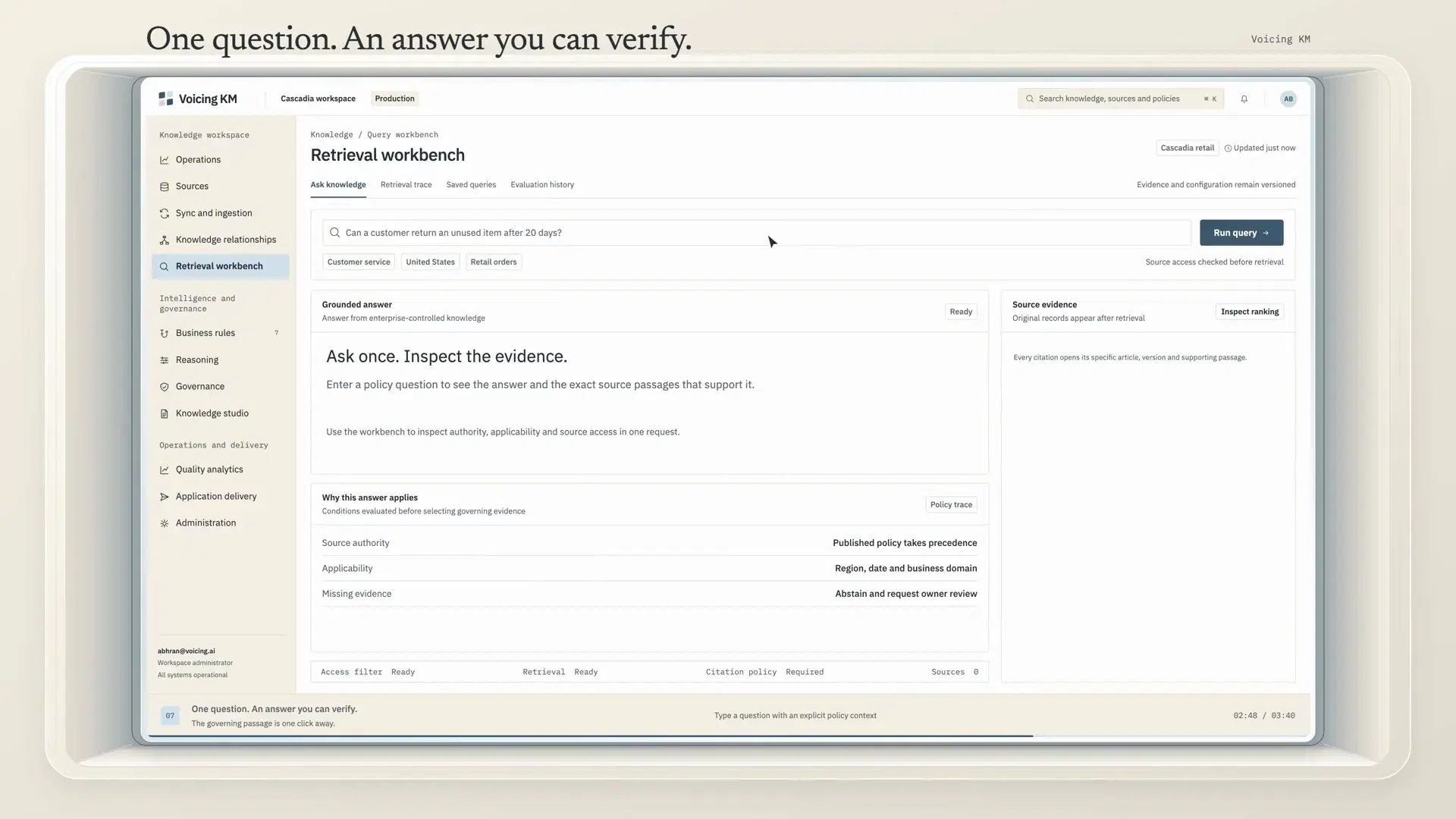
The citation opens the source.
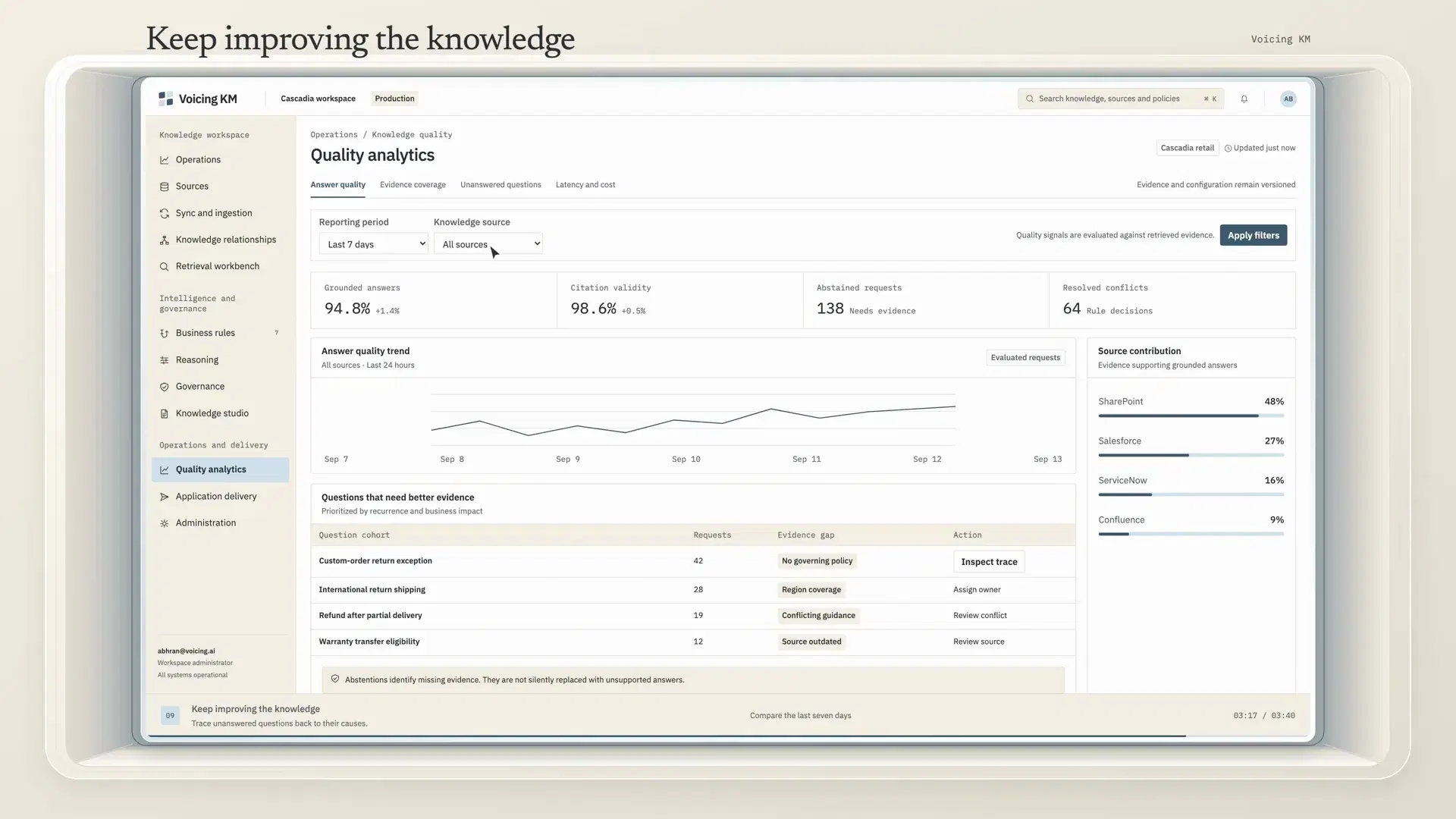
Kept with the evidence found.
Product demonstration with sample data
One customer question, followed across every connected system, through the rule that settles a disagreement, and on to the passage on screen that supports the answer.
Product demonstration with sample data
Each frame is a product demonstration with sample data and answers one evaluation question, from selection at the source to the correction of a wrong one; open any frame at full size with a click.
Selecting knowledge with a native query
Relationships across systems, shown together
Where sources disagree, and which governs
Permissions applied before retrieval
A grounded answer beside its passage
Thin evidence says so instead of answering
A correction, reviewed and published
Knowledge Mesh is deployed with the Voicing runtime, on-premises, in your cloud or in Voicing Cloud, so the layer, its index and its records fall inside one boundary that procurement reviews once.
Knowledge Mesh
There is no published Knowledge Mesh case study yet; ask us for a demonstration against your own sources.

Comprehensive in, salient and cited out
A working session with an engineer who has deployed inside a bank’s perimeter. We map your telephony, data boundary and handoff rules, and tell you what we would not automate.